catalogGPT
Make your products
the answer AI recommends.
50 million shopping queries hit ChatGPT every day. Most merchant catalogs are invisible to all of them. catalogGPT is the AI-readability layer that changes that.
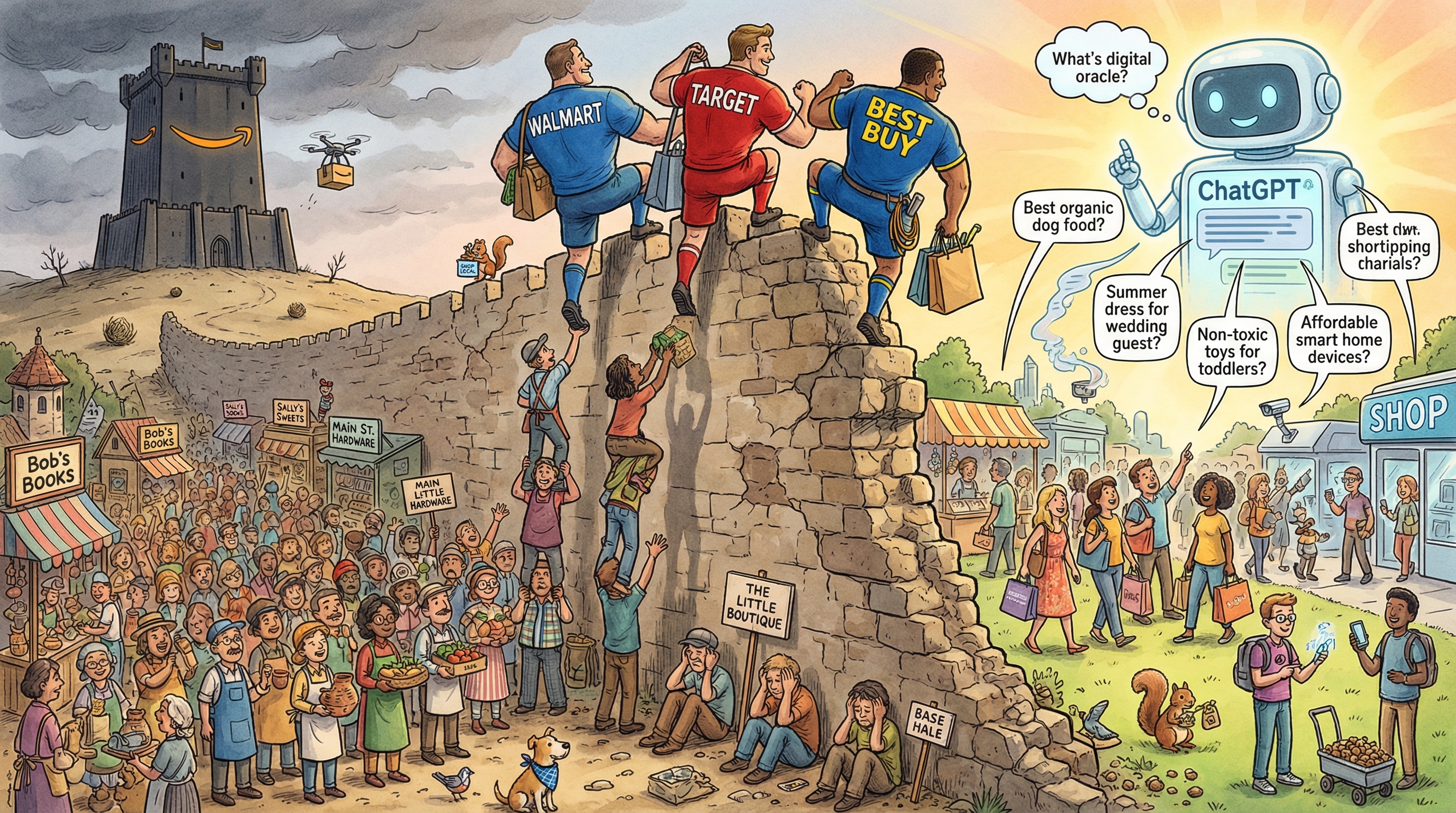
Big retailers are already on the other side of the wall.
Walmart, Target, and Best Buy have the structured data, the brand authority, and the catalog infrastructure to show up in AI recommendations. Most small merchants are still trying to find the door. catalogGPT is the door.
Raw product data is invisible to AI.
AI shopping agents can only recommend products they can understand. Raw catalog data (sparse titles, missing attributes, no structured schema) is unreadable to systems like ChatGPT, Gemini, Claude, and Perplexity.
Merchants who enrich now will be the ones AI recommends by Holiday 2026. The advantage compounds — every week your catalog is AI-readable and a competitor's isn't, you take their recommendation.
Your catalog data is securely siloed and never shared with other merchants or third parties.
Ingest. Enrich. Distribute. Learn.
catalogGPT is a loop, not a one-time enrichment. It continuously maintains your catalog's AI readiness as products change — and learns from how shoppers search.
Ingest
Syncs with your catalog automatically via Shopify or direct API. No manual data entry, no CSV uploads.
Enrich
Proprietary AI processes every product, extracting attributes, generating descriptions, mapping relationships, and tagging visual attributes.
Structure
Enriched data is transformed into complete schema.org Product markup, embedded as JSON-LD on every product page. Price, availability, brand, GTIN, and attributes, structured to the standard that Google, ChatGPT, and Perplexity actually parse. Q&A pairs and product ontology layers are added for deeper AI agent comprehension.
Distribute
AI-ready product feeds are generated and pushed in parallel to ChatGPT (ACP), Google AI Mode and Business Agent (UCP), Perplexity Shopping (Schema.org), and Claude (MCP). One enriched source feeds every protocol.
Monitor
Ongoing: new product detection, catalog change monitoring, AI compatibility checks, and feed health alerts.
Learn
For merchants running shopperGPT, the loop closes: real shopper queries, image searches, and zero-result misses from your own storefront flow back into enrichment. Your catalog learns the language your shoppers actually use — context no feed tool can see.
The format AI agents actually speak.
AI shopping agents don't browse pages like humans do. They parse structured data. Schema.org JSON-LD is the industry standard that tells AI systems exactly what a product is, what it costs, and whether it's available. Most Shopify stores ship with incomplete or missing markup. catalogGPT generates the full spec, for every product, automatically.
Complete schema.org Product markup
catalogGPT generates all required and recommended fields: name, description, image, brand, offers (price, currency, availability), SKU, GTIN, and category. Not the minimum. The full spec, populated from enriched product data.
Delivered as JSON-LD
JSON-LD is Google's recommended format and the standard AI crawlers parse. It lives in the page <head>, invisible to shoppers, essential to machines. No impact on page performance or visual layout.
Kept current automatically
Price changes, inventory updates, new products. catalogGPT detects them and refreshes structured data feeds within hours. Stale schema markup signals unreliable data to AI systems. Current schema signals a trustworthy source.
Twenty years of search rewarded short titles. AI rewards complete context. catalogGPT writes both — clean for humans, deep for machines.
AI shoppers ask questions. catalogGPT writes the answers into your catalog.
Shoppers don't type keywords at AI agents — they ask in full sentences, compare options, and narrow down with "which one." Specs alone can't answer those questions. catalogGPT enriches every product with the conversational layer the new protocols were built for.
Generated product Q&A
AI shoppers ask full-sentence questions: "Will this work for a fall wedding?" "How does it fit?" catalogGPT generates the answers — product-level Q&A pairs written into your structured data, so AI agents recommend with confidence instead of skipping you.
Pairings, occasions, and use cases
UCP’s conversational attributes are where AI agents look for context beyond the spec sheet. catalogGPT populates them automatically: what pairs with this product, what occasion it suits, who it’s for.
Your side of the story
AI agents weigh whatever they find — including stale reviews and third-party noise. Structured Q&A and rich attributes are how you put authoritative, merchant-owned answers in front of the agent first.
Every AI shopping channel. One platform.
catalogGPT generates and maintains compliant feeds for all five major AI discovery protocols simultaneously.
ChatGPT / OpenAI ACP
Agentic Commerce Protocol. Direct ChatGPT shopping surfaces. Over 1M Shopify merchants onboarding.
Google AI Mode + Business Agent
Google's branded AI agent in Search. Accuracy depends entirely on structured product data quality. catalogGPT generates it automatically.
Perplexity Shopping
"Buy with Pro" for U.S. subscribers. Reads structured product data and retailer feeds.
Shopify UCP
Universal Commerce Protocol. Co-developed with Google, launched January 2026. Real-time Catalog Endpoint, Identity Linking, multi-item Cart.
Claude / Anthropic MCP
Model Context Protocol. The agent-to-tools layer becoming standard across Claude, Cursor, and any MCP-compliant host. Your catalog becomes an agent-callable tool.
Why this matters right now.
The AI commerce infrastructure went live in early 2026 — and shopper behavior is already there. The gap between merchants who act and merchants who wait is widening every week.
The infrastructure just went live
UCP launched January 2026. Google's Catalog Endpoint shipped March 2026. OpenAI's ACP has 1M+ Shopify merchants onboarding. These are production systems querying product data today.
The standards war has four sides
OpenAI's ACP, Google and Shopify's UCP, Anthropic's MCP, and Schema.org JSON-LD are not converging. Picking a single protocol carries platform risk. Generating all four is the only safe bet.
Nobody else does this
Feed management tools handle distribution. AI content tools handle marketing copy. No existing player combines multi-modal product enrichment with compliant feed generation across all major AI shopping protocols.
From $99/month
Essentials starts at 1,000 products. Scale to 50,000+ with annual plans. Month-to-month, no contract required.
Be AI-ready by Holiday 2026.
Make your catalog readable, structured, and ready for AI shopping agents now. Start with the tier that fits your catalog, then expand as your needs grow.
Start with catalogGPT →