
The Commerce Search Problem Nobody Is Talking About — And the Store That Just Solved It
A new age of commerce search and discovery starts today. Here's what it looks like — with 8,000 real products, real shoppers, and a before/after you can see for yourself.
(Grab a coffee — 7-8 min, worth it.)
The Industry Is Asking the Wrong Question
Pick up any e-commerce trade publication right now. Attend any retail conference. Scan any VC deck about the future of commerce.
Everyone is asking the same question: How do merchants get their products discovered by AI answer agents like ChatGPT, Perplexity, and Google?
It's a reasonable question. And it is almost entirely the wrong one — especially for the 99% of merchants who aren't named Amazon, Walmart, or Target.
Here's the question merchants should actually be asking:
How do I stop AI answer agents, giant marketplaces, and comparison engines from siphoning my customers, my margin, my data, and my brand relationships away from my store — before they ever arrive?
Those are two different problems. The industry is building solutions for the first one. No one is building for the second.
That changes today.
What's Actually Happening to Independent Merchants
When a shopper goes to ChatGPT and asks “what's a good flowy midi dress under $80?” — and ChatGPT recommends a product — that shopper may never visit your store. They bought through an AI agent. The sale happened off your turf, on someone else's infrastructure, without your brand messaging, your email capture, your upsell logic, or your customer relationship.
Amazon and Walmart have the scale and the infrastructure deals to be the answer. They're inside those agents. They're building the pipes.
The independent merchant? They're hoping to get lucky in an AI recommendation. They're optimizing for GEO (Generative Engine Optimization) — trying to make their catalog more visible to agents that may cut them out of the relationship entirely.
Meanwhile, the shopper who does land on their Shopify store gets met with a keyword search bar from 2014.
That is the real gap. And it is enormous.
The Right Battleground: Onsite Discovery
When a shopper is on your store, you have everything:
- Your brand — the voice, the story, the aesthetic they came for
- Your margin — no marketplace cut, no agent transaction fee
- Your data — behavioral signals, purchase history, preferences
- Your relationship — the email, the loyalty program, the repeat customer
Onsite search is where that shopper converts — or doesn't. It's where discovery becomes revenue, or doesn't.
And for the vast majority of Shopify merchants, onsite search is broken. Not a little broken. Foundationally broken. Keyword matching. Zero semantic understanding. No color intelligence. No visual similarity. Type “blue dress” and get products tagged “blue dress.” Type “something flowy for a beach wedding” and get nothing useful.
Now imagine that problem across 8,000 products. A shopper lands on your store. She knows what she wants — a silhouette, a color, a vibe — but she can't find it through a keyword bar, and she doesn't have 45 minutes to scroll. She leaves. That sale is gone.
The irony is devastating: merchants are spending energy optimizing for AI agents that might cut them out — while their own store search is still powered by technology that would have felt dated in 2010.
That is what shopperGPT is built to fix — and for the dropshippers among us, cleanerGPT fills in the missing piece.
Introducing Cassie's Kurations — The First Live Store
Today I'm announcing that Cassie's Kurations — a Shopify fashion store for Gen Z and Millennial women — is live with both shopperGPT and cleanerGPT fully deployed.
This is not a demo environment. This is a real merchant, a real catalog of over 8,000 women's fashion items, real shoppers.
- cassieskurations.com — the live store with shopperGPT deployed
- cassies-before.vairetail.com — the same store with native Shopify search (pw:
dirty-data)
Open it up. Search for something. The difference is immediate.
A New Search Paradigm for Independent Merchants (shopperGPT)
shopperGPT is the headline product — a discovery experience purpose-built for the independent merchant. With 325K+ lines of patent-pending AI-Native code, it delivers three search modalities that, in combination, have no equivalent in any current commerce search product on the market.

1. Natural Language Search
Shoppers type the way they think, not the way databases are indexed.
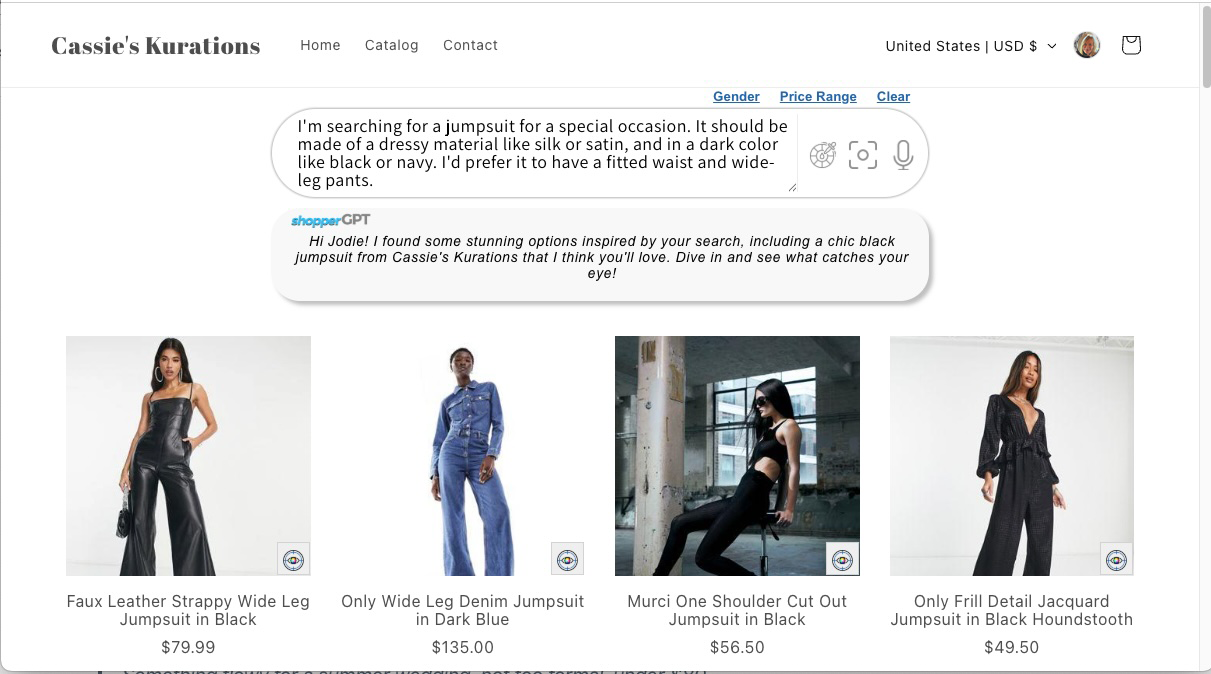
I'm searching for a jumpsuit for a special occasion. It should be made of a dressy material like silk or satin, and in a dark color like black or navy. I'd prefer it to have a fitted waist and wide-leg pants.
shopperGPT parses intent — garment type, occasion, formality, price constraint — and retrieves semantically matched products from all 8,000+ items in the catalog. Not just products tagged “summer” and “wedding.” Products that match the intent.
This includes price filter support within natural language queries — a capability no major commerce search platform currently offers inline.
2. Precise Color Search — 16 Million Shades
“Red” is not a color. Commerce search treats it like one.
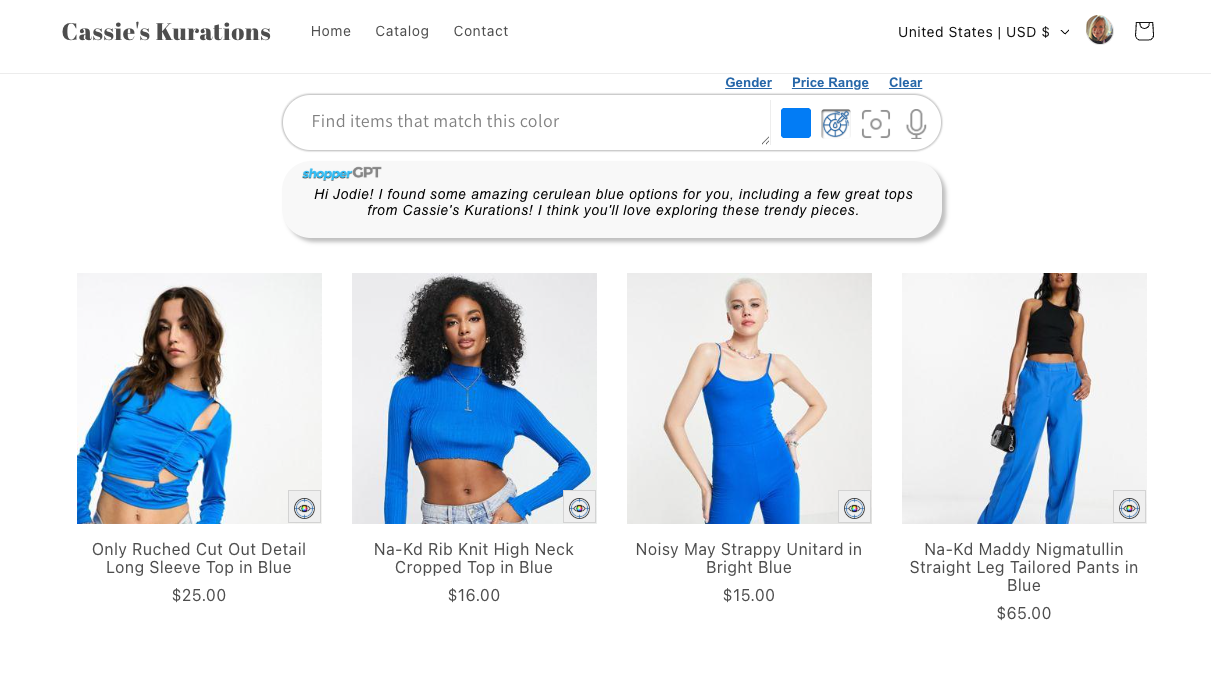
shopperGPT's 16-million-shade color picker lets shoppers select an exact color — not a color category — and retrieves products with real-time embedding matching against actual product imagery. The difference between coral and salmon. Between forest green and olive. Between slate and steel blue. Across 8,000 items, this turns browsing into finding.
No one else does this at this level of precision.
3. Multimodal: Color + Natural Language Combined
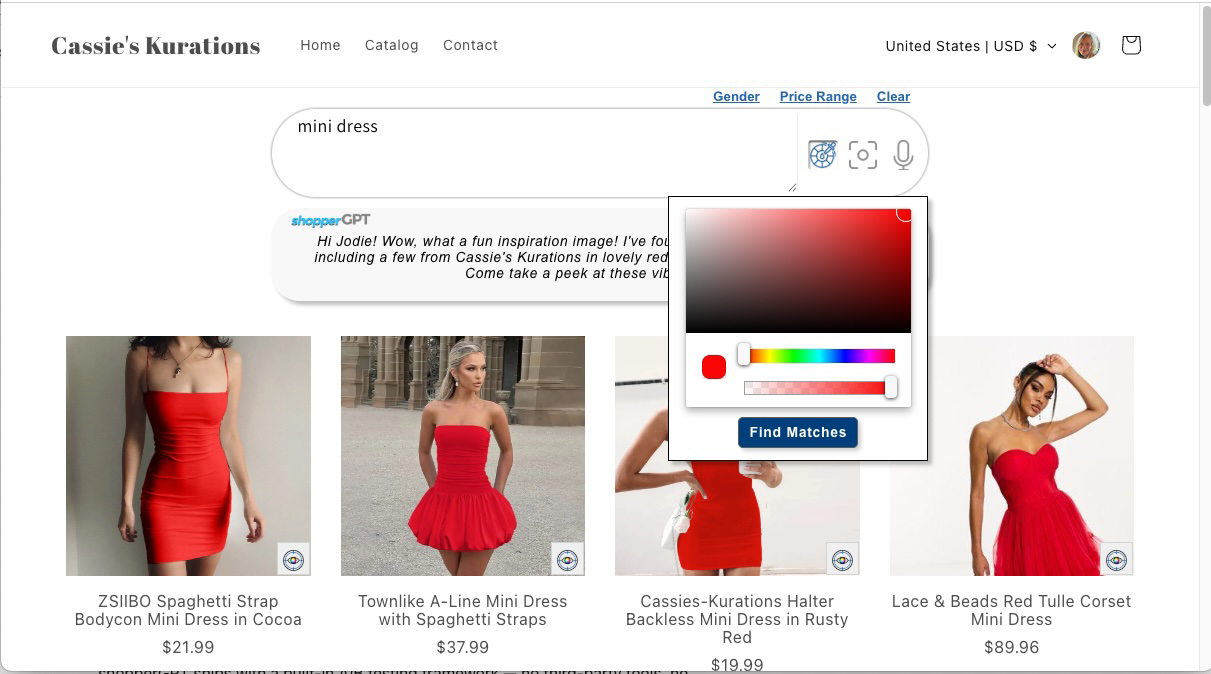
The most powerful mode. A shopper selects an exact shade of dusty rose and types “midi dress, flowy, casual” — shopperGPT finds products matching both the visual color signal and the semantic intent simultaneously.
This is how people actually shop. They have a visual in mind and a context. For the first time, a merchant can serve that — across a catalog of 8,000 items, in under three seconds.
4. Image Similarity Search
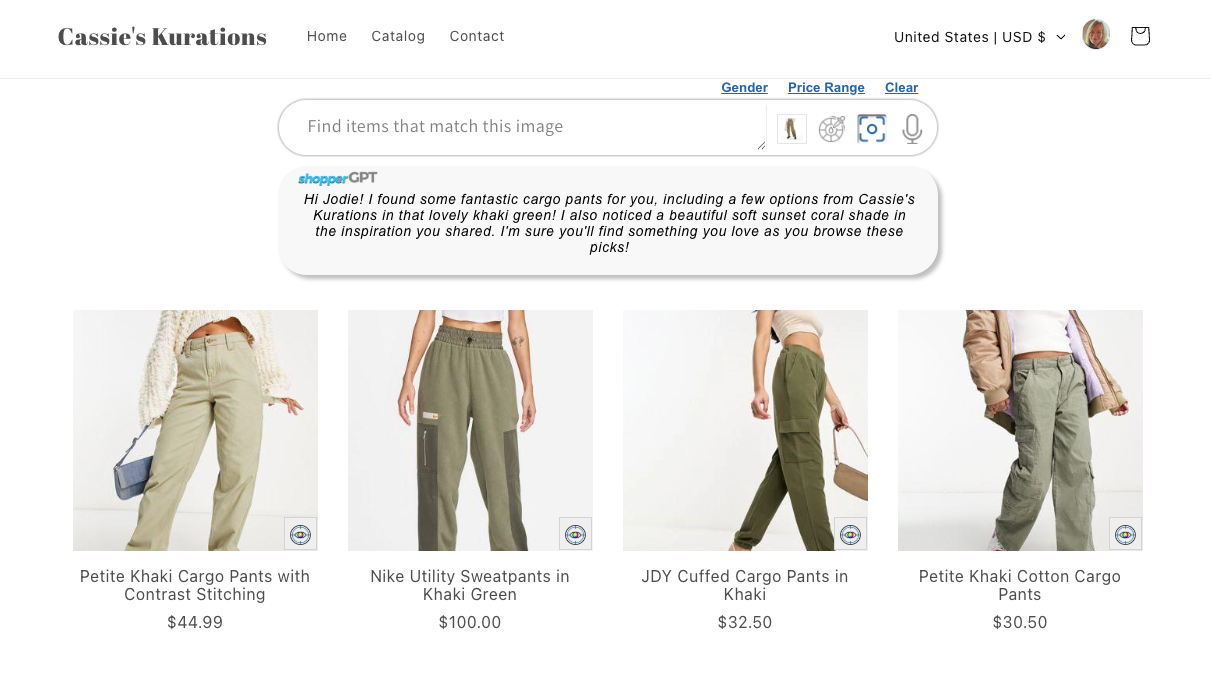
Sometimes a shopper has a picture, not a phrase. A screenshot from Instagram. A photo of an outfit they saw on the street. A product image from another store. shopperGPT takes that image, understands silhouette, garment type, color palette, and styling cues, then surfaces visually similar items from the merchant's catalog.
No tagging required. No metadata setup. The image itself is the query — parsed against real product imagery using the same embedding pipeline that powers natural-language and color search.
How Do We Know It's Working? (A/B Testing Built In)
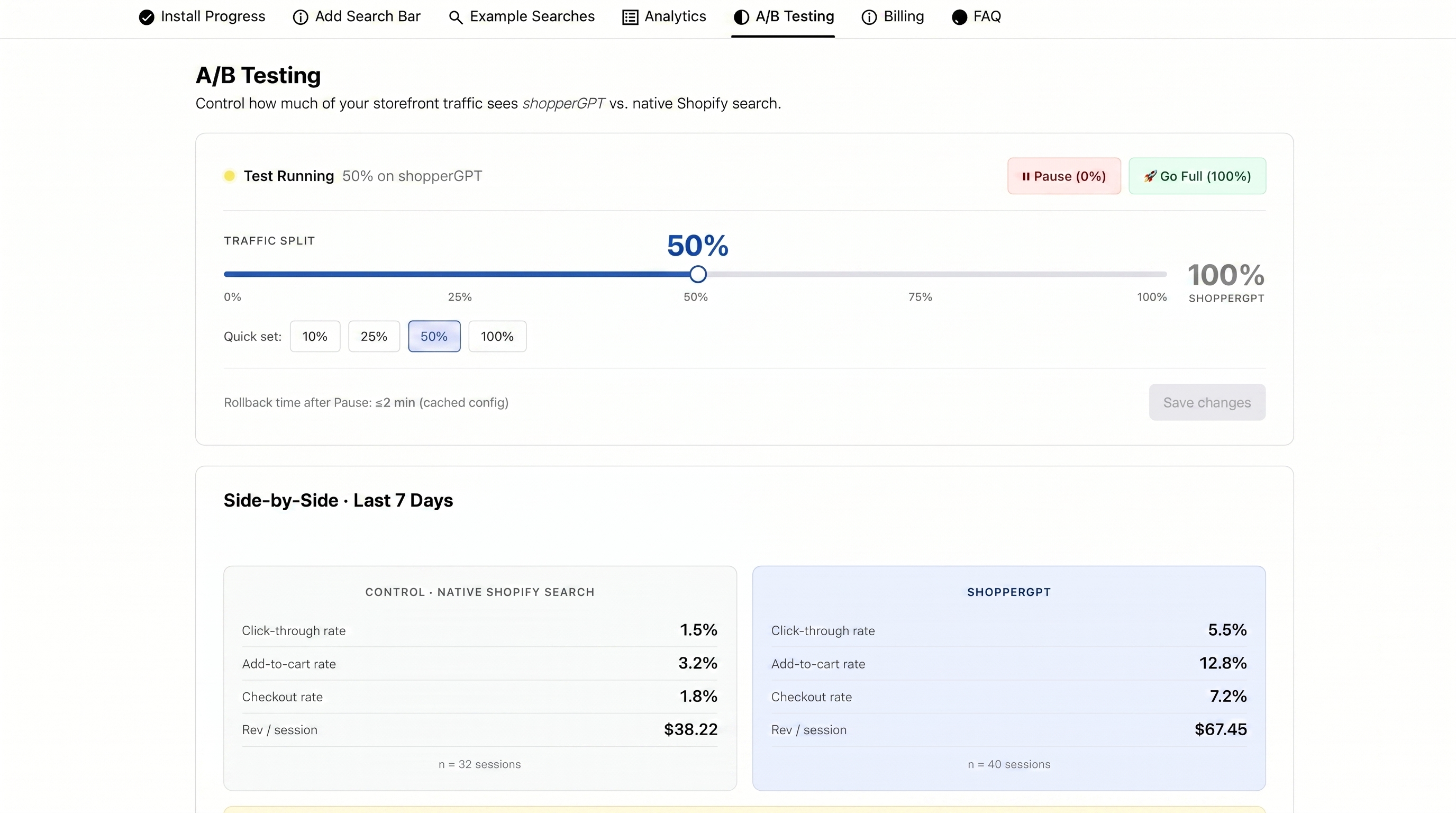
shopperGPT ships with a built-in A/B testing framework — no third-party tools, no engineering work required.
A configurable traffic split (default — 0% (zero risk), adjustable from 1–100%) routes shoppers between shopperGPT and whatever search they used before. The dashboard tracks search-to-click rate, click-to-cart rate, conversion rate, and revenue per search session.
Merchants don't have to take our word for it. They see the delta in real-time, on their own store, with their own shoppers.
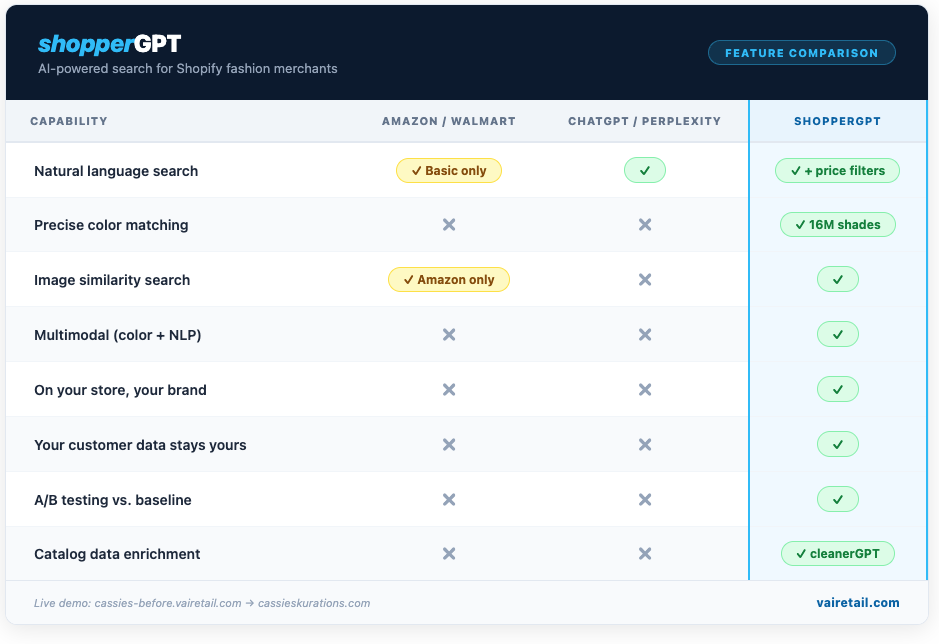
How It Compares vs. the Giants
Time to discovery: seconds vs. minutes of traditional browsing across 8,000 items.
The point is not that shopperGPT beats Amazon on scale. The point is that an independent merchant — a boutique, a dropshipper, a one-person operation — can now deliver a search experience that is on par with or ahead of the largest retailers and AI agents in the world, on their own storefront, keeping their own customers.
That has never been true before.
The Companion Product for Dropshippers (cleanerGPT)
shopperGPT delivers these results on a clean catalog. But for the 1M+ Shopify merchants who source from AliExpress and other suppliers — Cassie's Kurations included — the catalog they're handed is anything but clean.
That's the problem cleanerGPT solves. It's a complementary product, not a prerequisite. If you're a dropshipper, you almost certainly need it. If your catalog is already clean, you don't.
Here's what supplier data actually looks like for a typical dropshipper:
Raw supplier title:
2025 Autumn Long Sleeve Fashion Women Cardigans Sweater Knitted Coat Short Casual Single Breasted Korean Slim Chic Ladies Tops
Raw supplier description:
<h1>SPECIFICATIONS</h1><p>Age: MIDDLE AGE</p><p>CN: Guangdong</p><p>Material: Polyester</p>...
That is not an edge case. That is the majority of an 8,000-product catalog. More than 7,500 products arrived with titles over 100 characters, keyword-stuffed for AliExpress's internal search algorithm — not for human beings, and certainly not for AI.
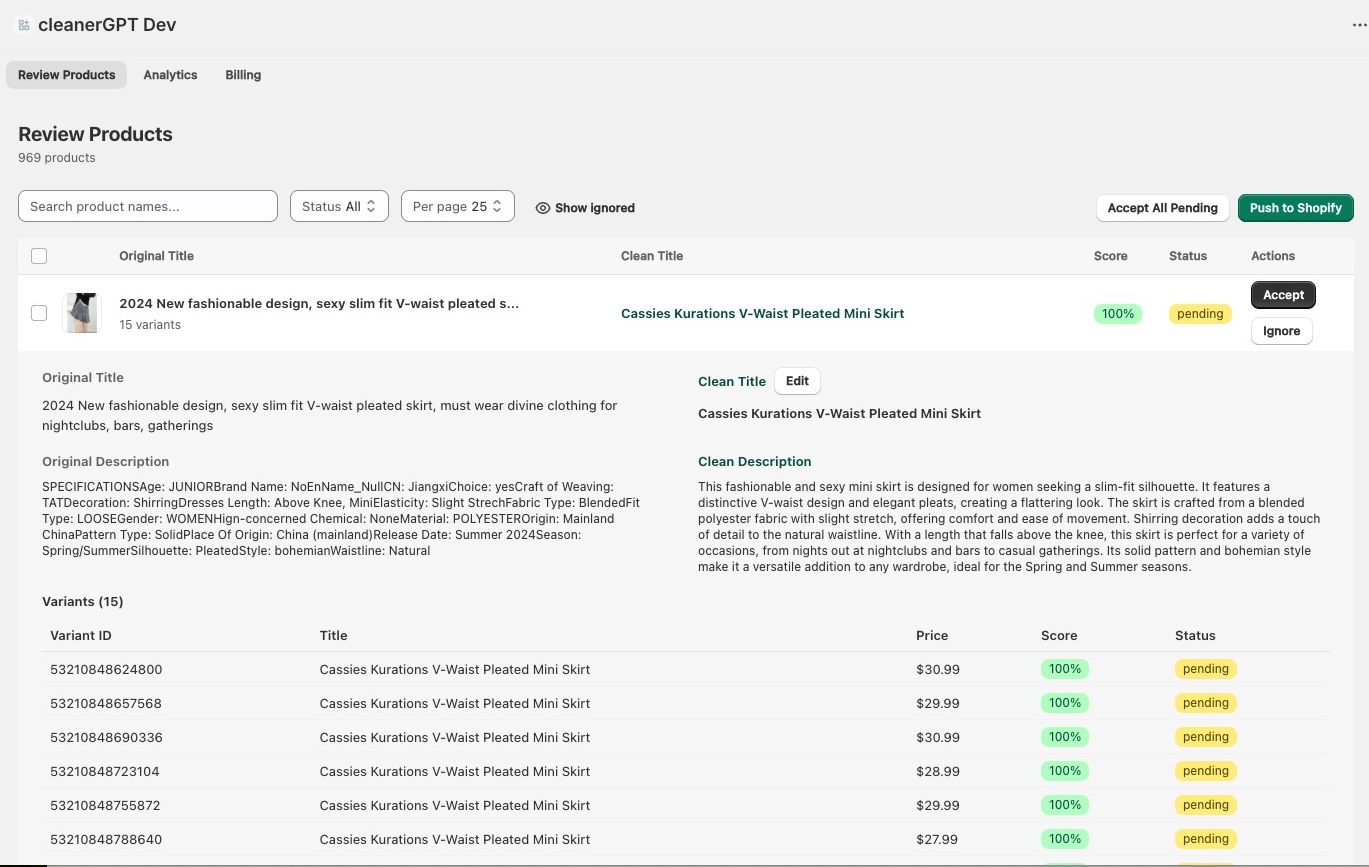
cleanerGPT processed Cassie's full catalog through a 5-step pipeline:
- Text and image analysis — cleanerGPT examines the product data and images to develop a complete assessment: fabric texture, silhouette, color, neckline, sleeve type, occasion fit
- AI title generation — Replaces the supplier's keyword-salad with a clean, human-readable title: “Open-Front Crochet Cardigan in Black”
- AI description generation — Replaces the HTML spec sheet with a natural-language product description a real shopper would actually read
- Quality scoring — Every generated title and description gets a quality score (0–1), flagging anything below threshold for manual review
- Human-in-the-loop approval — The merchant reviews before/after cards, approves or edits, then pushes to Shopify with one click. Full rollback available at any time.
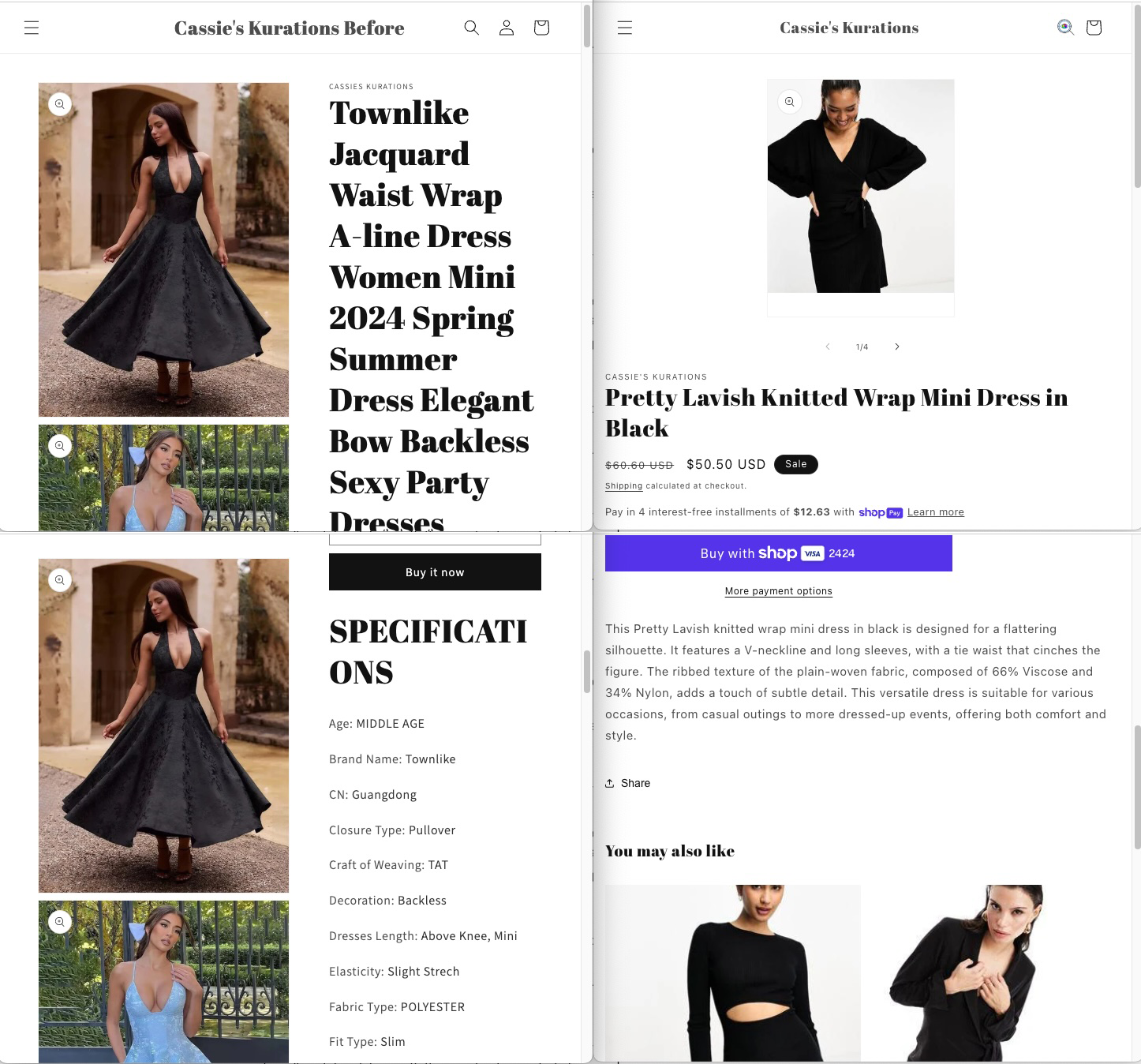
The result: 8,000+ products went from supplier junk to structured, AI-readable, shopper-friendly catalog data — with the merchant in control of every change. And shopperGPT, fed clean data, performs the way it's meant to.
See It On Yourself Before You Buy (studioGPT)
Five major virtual try-on launches landed in six months — Zara, Walmart, Amazon, Kmart Australia, Diesel. The giants are spending real money to set a new shopper expectation: see it on yourself before you buy. studioGPT is how an independent merchant matches that expectation today — and it's now live on Cassie's Kurations.
It's the first extension built on the same patent-pending engine as shopperGPT. Discovery and try-on share one flow: a shopper finds the right product by natural language, color, or image — then taps “Try It On” without ever leaving the page.
What's in the demo:
- Ultra-HQ on-model compositions — correct drape, fabric, and lighting, generated from the merchant's existing product photography
- Selectable poses — the shopper picks the view, not the merchant
- 10–15 second compositions — Amazon's published target is 30
- Saved outfits — build a full look across products and keep it
- Outfit checkout — the entire look goes to cart in one tap
- Fully responsive mobile — because 81% of fashion eCommerce traffic is on a phone
Why it matters, in the merchant's P&L: published apparel data shows try-on sessions converting at up to 2.3× the rate of non-try-on sessions, and return rates down as much as 40% on try-on orders. For a mid-market apparel merchant carrying a 25%+ return rate, that's not a feature — it's margin.
studioGPT is available as a custom Shopify install today for stores already running shopperGPT; Shopify App Store submission is in the coming weeks, with APIs for non-Shopify platforms arriving Q3.
Who This Is For
shopperGPT is focused initially on Shopify's 750,000+ fashion merchants. While the initial launch is fashion-vertical focused, we are actively evaluating additional verticals and custom API integrations for platforms outside Shopify.
cleanerGPT is built for Shopify's 1M+ dropshippers — any merchant whose product data comes from a supplier and has never been properly cleaned or enriched. At catalog scale, it's not optional infrastructure. It's table stakes.
shopperGPT and cleanerGPT both feature no engineering required, zero upfront costs, 1-click install, and pricing designed to be accessible at every merchant size, from solo operators to scaling brands. studioGPT installs as a custom extension on stores already running shopperGPT, with App Store availability in the coming weeks.
Founding Partners Program — 4 Spots Remaining
We're onboarding 5 Shopify fashion merchants before public launch — 90 days free, white-glove setup in 48 hours, founding pricing locked for life.
Apply directly or book a 30-minute call at vairetail.com/founding-partner — or DM me directly.
shopperGPT, cleanerGPT, and studioGPT have well over 325,000 lines of AI-native infrastructure code, with 34 patent-pending claims. Built over several years out of a labor of love for raising the bar for commerce merchants and a desire to level the playing field. We think a new era of commerce search started today. Not for Amazon or Google. For the other 6M+ commerce shops.
Joe Monastiero is founder of visualAI retail solutions — the AI discovery OS for commerce merchants: shopperGPT (AI search), cleanerGPT (catalog enrichment), studioGPT (virtual try-on, now live on Cassie's Kurations), and catalogGPT (AI-agent visibility, launching July 2026).